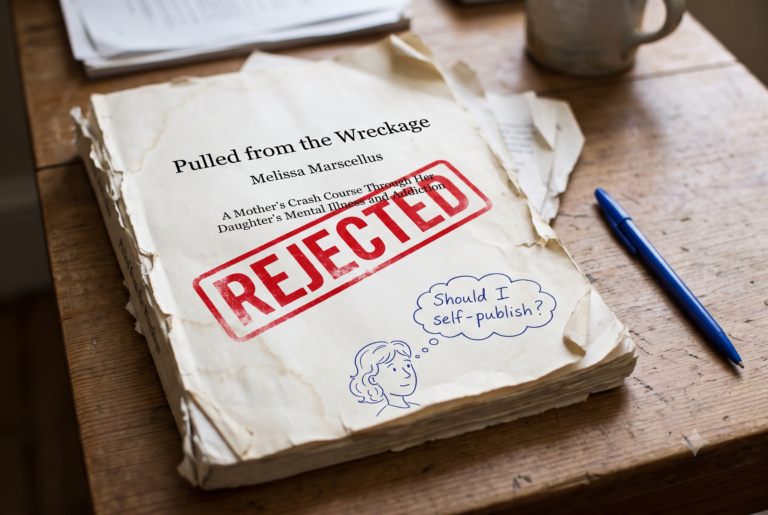
If you’re self-publishing a book like I am, you’ll want your manuscript to receive the same level of care and attention as a traditionally published title. Your final draft should be as polished and compelling as possible.
Even after completing multiple rounds of self-editing on my memoir, Pulled From the Wreckage, I wasn’t confident that my writing was actually good enough. I was getting ready to share a deeply vulnerable story about my family with the world, and I wanted an objective, expert opinion on my manuscript. I needed validation from a professional editor who would also help me avoid any cringe-worthy errors on the page.
Figuring out what kind of editing my manuscript needed was overwhelming. After completing multiple rounds of self-editing, there are several types of professional editing to consider.
The first and most basic type is an editorial assessment. This doesn’t include any editing on the manuscript itself but is a big-picture report that suggests areas for improvement to your book’s structure, themes, plot, pacing, length, voice, clarity, and character arcs. If you just want to know what works and what doesn’t, this could be an option.
Next is developmental editing. If you feel like the overall structure and theme of your book still needs work, this big-picture appraisal examines the same issues as an editorial assessment but would contain notes in the margin with specific suggestions for improvement. While it’s the most significant investment, you get the biggest bang for your buck because many developmental editors also include an editorial letter and at least some light line and copy editing.
Line editing is a hands-on, laser-focused sentence-by-sentence, paragraph by paragraph edit to enhance the writing itself. This will include in-line suggestions for improving sentence structure, word choice, clarity, and dialogue. If the bones of your book are sturdy, but you want help with your prose or dialogue, line editing is the way to go.
Often combined with line editing, copy editing focuses on the technical side of writing, looking for grammar, spelling, and punctuation errors. If your overall structure and prose are solid, but you’re terrible at spelling and aren’t sure where to place a comma in a sentence, copy editing is for you.
Finally, proofreading should be your last stop before your launch date. Your proofreader will be the final set of eyes to catch any remaining grammar and formatting issues before publication.
So how do you find a freelance editor, aside from conducting a simple Google search?
Reedsy is a great option because they vet their editors and require them to have traditional publishing experience. You can also rest easily knowing your payment is secure, and you have a legally binding contract. The biggest downside to Reedsy is the cost. Because their service fees are high, and you’re paying for a vetted professional, you’ll likely pay more for an editor than you would on sites like Fiverr or Upwork.
If budget is a major concern, it’s possible to find quality editors on Fiverr or Upwork, but it will take a considerable amount of time to sift through profiles to find a diamond in the rough. And ultimately, you get what you pay for.
So how much is all of this going to cost? Reedsy has a tool for calculating the price of each type of editing based on your manuscript word count. If your manuscript is roughly 80,000 words, you can expect to pay around $2,000 for an editorial assessment, $3,000 for a developmental edit, $2,400 for line and copy editing, and $1,700 for proofreading. If your manuscript is significantly longer or shorter, your cost will obviously go up or down.
But no matter who you hire, make sure to read their reviews, request a sample edit, ask for clarification about what their editing includes, and inquire about their process and expected timeline for your project. Request quotes from at least three editors to find the right fit.
For Pulled From the Wreckage, I hired a developmental editor whose package bundled structural feedback with line and copy editing. Real life doesn’t unfold in a neat, tidy arc, but I wanted to make sure my memoir did. It was important to me that I presented my family’s experiences with mental health in a way that was captivating and easy for others to understand. While I wasn’t sure I needed a full developmental edit, I thought it was the best value.
Later on, my final editing investment will be to hire a dedicated proofreader to catch any eleventh-hour slip-ups.
Next Up: I’ll detail what it’s actually like to collaborate with a developmental editor.